Counting the number of set bits (1s) in an integer's binary representation is a common task. While you can check every bit, Brian Kernighan’s Algorithm provides a much faster way by only iterating over the set bits.
The Concept
The core trick is the expression n & (n - 1). As we saw in our 'Power of Two' article, this operation always clears the rightmost set bit of a number.
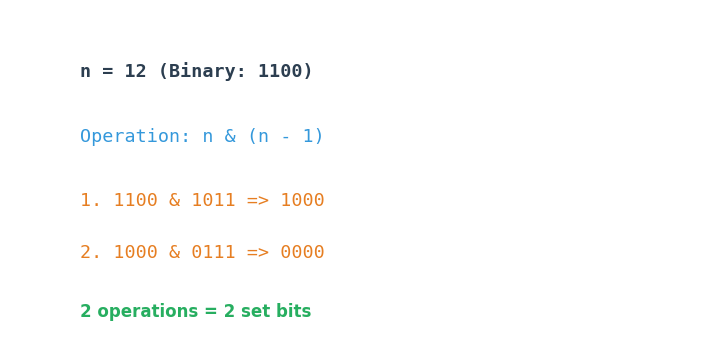
Algorithm
- Initialize a
countvariable to 0. - While the number
nis greater than 0:- Perform
n = n & (n - 1). This clears the rightmost set bit. - Increment
countby 1.
- Perform
- The loop ends when all bits are cleared (n becomes 0).
Python Implementation
def count_set_bits(n):
    count = 0
    while n > 0:
        n = n & (n - 1)
        count += 1
    return count

# Test: n = 12 (1100 in binary)
print(count_set_bits(12)) # Output: 2
Complexity
- Time Complexity: O(log N) in worst case, but specifically O(K) where K is the number of set bits.
- Space Complexity: O(1).
Thanks for feedback.