Checking if a number is a power of two is a fundamental bit manipulation task. While you could solve this by repeatedly dividing by 2, the bitwise approach is significantly more efficient, running in O(1) time.
Problem Statement
Given an integer n, return true if it is a power of two. Otherwise, return false. An integer n is a power of two if there exists an integer x such that n == 2^x.
Example 1
Input: n = 1
Output: True
Explanation: 2^0 = 1.
Example 2
Input: n = 16
Output: True
Explanation: 2^4 = 16.
Example 3
Input: n = 3
Output: False
Deep Dive: The Bitwise Logic
To understand why n & (n - 1) works, let's look at the binary representation of powers of two:
- 2: 0010
- 4: 0100
- 8: 1000
Notice that every power of two has exactly one bit set. When we subtract 1 from these numbers:
- 2-1 (1): 0001
- 4-1 (3): 0011
- 8-1 (7): 0111
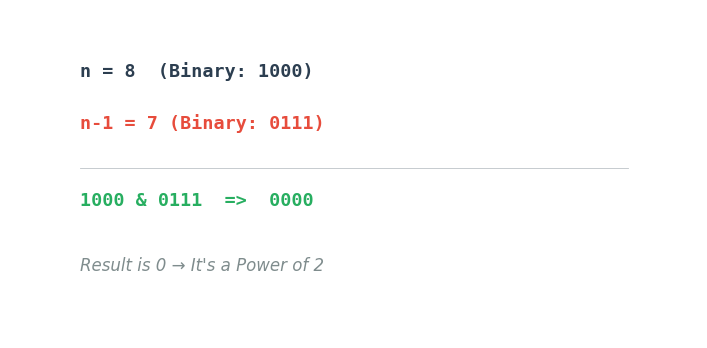
By subtracting 1, the only set bit becomes 0, and all bits to its right become 1. When we perform a bitwise AND between the original number (n) and (n-1), all bits will result in 0.
Step-by-Step Algorithm
- First, ensure n > 0. Negative numbers and zero cannot be powers of two.
- Perform the bitwise calculation:
result = n & (n - 1). - Check if the
result == 0.
Python Implementation
def is_power_of_two(n):
    # A power of two must be positive and (n & n-1) must be 0
    return n > 0 and (n & (n - 1)) == 0

# Test cases
print(is_power_of_two(16)) # True
print(is_power_of_two(10)) # False
print(is_power_of_two(1))  # True
Complexity Analysis
- Time Complexity: O(1) - The bitwise AND operation takes constant time regardless of the size of the number.
- Space Complexity: O(1) - No extra space is required.
Complexity Analysis
- Time Complexity: O(1) for bitwise check.
- Space Complexity: O(1).